
The greatest ideas in football often die the same way they are born—through imitation. What began as a revolutionary method for dominating opponents gradually became a sacred doctrine that could not be questioned. Spain’s golden generation had turned possession into an art form, but by the 2020s, the heirs of that dynasty seemed more concerned with preserving the philosophy than winning matches. Most teams used possession as a means to create chances but in Spain’s case, they had the idea that the with heavy possession of the ball, opponents can’t hurt you. Their heavy possession model was designed to control the entirety of the game. The ball became both an attacking weapon and a defensive shield. In the Euro 2008, Spain completed more passes than any other team in the tournament. Their victory in the final against the Germany national team was important but the manner was even more important. From then on, a new footballing superpower emerged.
By the time the 2010 World Cup arrived, the tiki taka model had evolved from an idea to a fully functioning system. Under their coach then Vicente del Bosque, their objective was no longer to control the game but suffocate opponents. Spain alwyas sought numerical advantage around. Every player offered a passing option and the opponents are often forced to chase. All these was made possible with the combination of Xavi Hernandez, Andreas Iniesta, Sergio Busquests, and Xabi Alonso. They were arguably the greatest international midfield unit ever assembled.
Spain completed more than a thousand passes against Morocco in the 2022 World Cup. They monopolized possession, controlled territory, and spent most of the match with the ball at their feet. Yet when the final whistle blew, the scoreboard read 0-0, and a penalty shootout sent them home. It was the ultimate footballing contradiction; Spain had everything except what mattered. In that moment, tiki-taka did not merely fail—it was exposed. In the Round of 16 match against Morocco in Qatar, Luis Enrique and his team were defeated by the then dark horse of the tournament—Morocco. During the match, Spain had 77% of the ball, fashioned 3 big chances with 1 shot on target whilst the eventual winners of the tie had less dominance of the ball but more directness. During the match, Spain’s possession became sterile. It showed that the system only generates control but not chaos. It dominated statistics but not the opponents. In Enrique’s tenure as coach, the team was bordered around extreme heavy possession, constant circulation, high pass volumes, and limited vertical risks which made them predictable, and boring to watch.
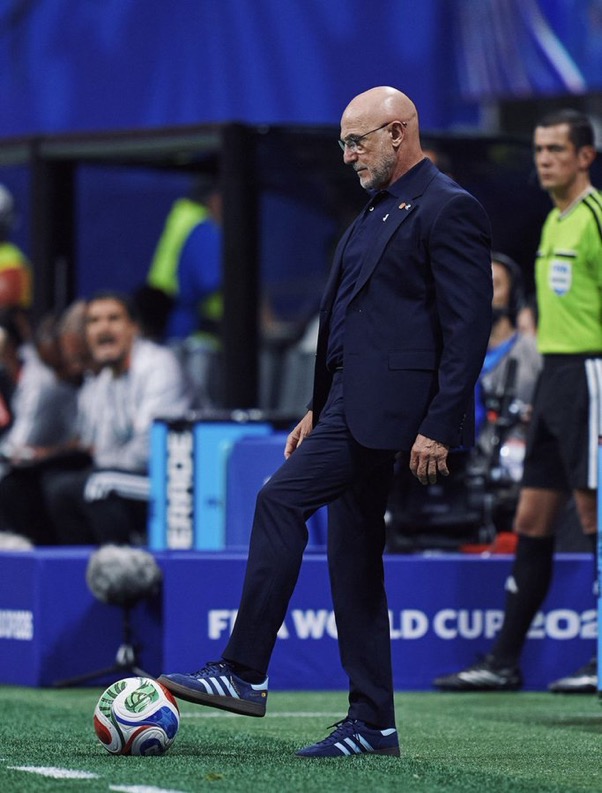
With Luis de la Fuente’s appointment after Qatar 2022, the expectation was continuity. Another Spanish coach. Another possession advocate. Another custodian of the nation’s footballing religion. Instead, what followed was something closer to a revolution disguised as succession. There were three tactical changes De La Fuente implemented that changed everything for the Spanish national team; faster vertical attacks, the use of width returning to Spanish football, and off the ball aggression.
De La Fuente’s Spanish side plays a more vertical, flank-focused, and direct brand of football as opposed to the methodical, patient possession style under Luis Enrique. Luis Enrique’s side took 78.7 passes per shot as opposed to De La Fuente’s 35.3 passes per shot looking to bypass deep lying defenses rapidly by funneling the ball to the wide attackers. Also, De La Fuente’s side averages 34.8 touches I the opposition box per 90 compared to just 22.8 under Enrique. De La Fuente averages 2.54 non-penalty goals per 90 minutes, a significant increase from Enrique’s 1.6. While both coaches rely heavily on a base of high possession and high pressing, De la Fuente has transformed Spain into a more penetrative and aggressive side.
Under Luis De La Fuente, Spain changed their defensive structure to a more targeted mid-high block as opposed to Enrique’s suffocating counter pressing at all costs system. While both managers command teams that dominate territorial pressure, their defensive metrics reflect their different possession structures. Luis De Fuente’s side(9.5 to 10.8) allowed more PPDA( Passes per defensive action) shifting from an extremely intense defensive structure under Enrique(7.5-8.5) to a more selective one allowing opponents slightly more passes before engaging. While Enrique forced a higher sheer volume of turnovers, his press was inherently high-risk. If the first wave failed, Spain was intensely exposed to direct long balls. De la Fuente’s pressing traps are more selective and winger-guided. As a result, Spain’s success rate (the percentage of presses that result in a turnover within 5 seconds) went up because the traps are sprung with tighter defensive covering behind.
Every great Spanish side has had a conductor. A player who dictates rhythm, controls space, and ensures chaos never overwhelms order. For this generation, that responsibility belongs to Rodri, the man who transformed midfield control from an aesthetic exercise into a weapon. he foundation, he provides control and defensive security. Every phase of play flows through him just like Busquets was but with more physicality.
Some players see passes, Pedri sees possibilities. The Chief playmaker in a team increasingly built on speed and verticality, he remains the bridge between Spain’s technical past and its dynamic future, turning moments of possession into moments of danger. Breaking defensive lines and supplying creativity that turns possession into chances.
For more than a decade, opponents feared being passed to death by Spain. Today, they fear something different. They fear being isolated against two wingers capable of turning a harmless situation into a crisis within seconds. Lamine Yamal and Nico Williams are not accessories to Spain’s attack—they are the attack. Their pace, dribbling and directness gives Spain a threat in transition which wasn’t the modus operandi(mode of operation) for the previous generation.
Tactical revolutions are easy to describe and difficult to prove. Plenty of coaches promise change; few deliver silverware. Euro 2024 provided the evidence. Spain did not just win the tournament—they won it in a manner that confirmed their transformation was real. History will remember Spain’s golden generation for perfecting tiki-taka, but the next great Spanish team may be remembered for something far more difficult: knowing when to let it go. De la Fuente’s greatest achievement was not preserving Spain’s footballing identity. It was having the courage to evolve it.